Over the past year, lots of people have asked me what I think of the argument Jean-Baptiste Fressoz makes in More and More and More - that sources of energy are only ever additive. TLDR: not much.
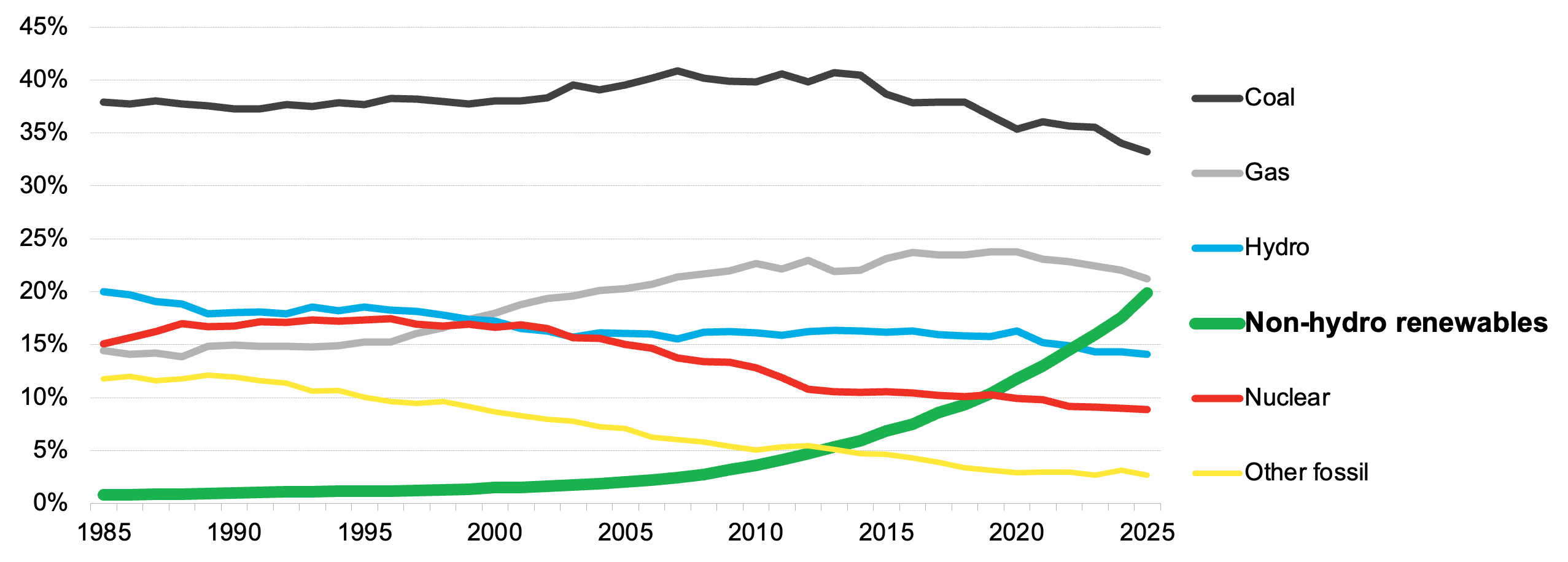
Global share of power generation by source 1985 - 2025. An obvious logistic curve has emerged. Source: Liebreich Associates, IEA, BP, World Bank
Earlier this year, a journalist who had written a lengthy piece about Jean-Baptiste Fressoz’s book More and More and More contacted me with a series of questions. She wanted to know if I agreed with his thesis, and if not, why not. I took the time to provide detailed answers, but as far as I can see she never used them. Perhaps she found them unconvincing, or too technical, or perhaps her editor felt the Zeitgeist was wrong to defend the transition. In any case Fressoz remained unchallenged in the outlet for which she writes.
I recently came across the email with my answers, and thought some people might find them useful. So here they are, lightly edited.
Q: According to a recent book by Jean Baptiste Fressoz, we are looking at the energy transition completely wrong—it is, in his words not a transition, but an addition. Energy demand keeps growing, energy sources keep being added, but none are ever removed. How do you see that?
A: Fressoz creates a simplistic straw-man - successive transitions from wood, to coal, to oil and gas, and finally to renewables. He then creates his own simplistic narrative: the idea that each new form of energy has only ever been overlaid on what came before. He uses selective historical data to claim that this is some sort of natural law, “a completely new understanding of the dynamics of energy”. It’s a claim which, if true, would have profound implications for society as it tries to address climate change, and which has been welcomed and amplified by opponents of clean energy.
Luckily, the claim is easily debunked. Fressoz does not have a background in either the engineering or the modelling of energy systems, and my goodness it shows.
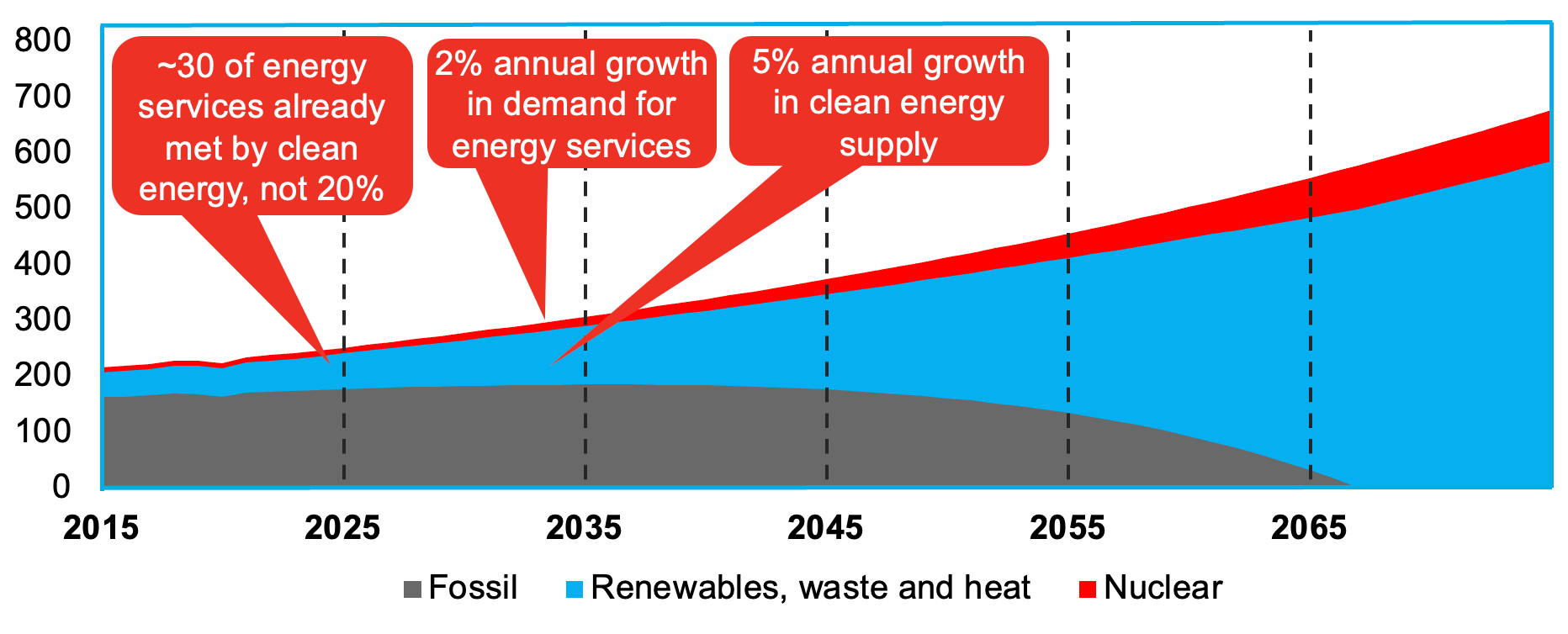
His “completely new understanding” begins with the absolutist thesis that a transition is only a transition if it entirely eliminates that which came before. Clearly, if your only definition of a low-carbon transition is one characterised by a rapid and complete elimination of fossil fuel burning, then it is not happening. What is happening though, as I described in Part I of my Pragmatic Climate Reset, is that clean energy is growing faster than energy demand, and is likely to continue to do so. As long as this goes on for a decade or two more, then fossil fuels will, by simple arithmetic, be forced into retreat:
Illustrative model of global energy demand and how it’s met (Exajoules/yr), if clean energy outgrows demand for energy services by just 3% per year for a few more decades. Adapted from the Pragmatic Climate Reset, part I. Source: Bloomberg, Liebreich Associates.
How quickly this proceeds, and whether fossil fuels are ever entirely forced off the system, is not the point*. The point is that clean energy will, within a few decades become the dominant source of energy in our economy, just as wood once was, then coal, then oil and gas - which for most people would be enough to qualify as a transition.
Telephony provides an analogy. In 1973, when the mobile phone was first demonstrated, there were only land lines. Today there are 12 times as many mobile phones as land lines. By any reasonable description, the world is transitioning from land lines to mobile telephony. Until 2006, however, the number of land lines continued to grow; a contemporary Fressoz would have jumped up and down, claiming a “completely new understanding” that mobile phones are only ever “additive” or “symbiotic with” land lines. Indeed I met people like that.
The transition to mobile telephony wasn’t a failure just because the global number of landlines continued to grow until 2006, 33 years after the invention of the mobile phone. Similarly, the transition to internal combustion vehicles didn’t fail because peak US horse population only occured in 1920, over 34 years after the first internal combustion vehicle hit the roads.
If something walks like a transition, swims like a transition and quacks like a transition, it’s probably wise to wait 30 years before saying you’ve proven it can’t be a transition.
Q: Fressoz claims that historically, energy sources have always accumulated and complemented rather than replaced one another. Is he right?
A: No, he’s wrong. He has chosen the wrong scale and system boundary for his analysis. First, he ignores or dismisses once-dominant examples of energy sources that have disappeared entirely – human power, oxen, whale oil, pit ponies, railroad and naval coal, town gas, canal horses, district hydraulic power, water wheels, wind-powered grinding mills, and many more.
Then, for the fuels he does consider, he uses data at the global level that obscures dynamics at the level of granularity at which competition between technologies actually plays out: sector by sector, market by market, geography by geography.
Overall, the world continues to burn wood, charcoal and animal dung. Fressoz would have us believe that’s because there is a natural law that says that as one user moves on, another takes their place. In reality, while demand for traditional biomass soared in the global south at the same time as it collapsed in the developed world, it was obviously for completely unrelated reasons. As global south countries develop, they too are transitioning away from traditional biomass. Interestingly, big emerging markets like India and Africa are to an increasing extent leapfrogging the coal and oil stages, heading directly for electrification, generally in combination with gas. Industrial biomass power generation (in power stations like Drax) is lumped in with cooking with wood and charcoal as though the arrival of the former was caused by a decline in the latter.
Fressoz completely misses the super-trend of electrification. In 1970, electricity met around 10% of energy demand, now the figure is around 30%. By energy demand, I mean demand for energy services, Useful Energy, not electricity as a share of Final Energy, which includes all the thermal waste incurred in internal combustion engines and excludes ambient heat captured by heat pumps. And certainly not electricity as a percentage of Primary Energy, which anyone who has heard of the Primary Energy Fallacy knows is really a measure of supply, not demand.
In fact, does Fressoz understand that a joule of electricity can deliver a multiple of the energy services delivered by a joule of coal, oil or gas? Has he ever heard of exergy, the ability of an energy source to do work? Does he think that all heat at all temperatures is equal? Like so many of the leading defenders of fossil fuels (looking at you, Bjorn Lomborg), he appears to lack the basic understanding of thermodynamics his work so obviously demands.
What the global economy really needs is energy services, or Useful Energy: light, heating, mobility, process heat at various temperatures, and work. As soon as you use as a metric Primary Energy, you are mainly measuring levels of thermal waste, the vast majority of it from legacy fossil fuel technologies.
You’re looking through the wrong end of the telescope and seeing only the reflection of your own priors. It would be like measuring the ability of agriculture to feed people, based purely on how many acres are under cultivation: you would miss the impact of productivity. Norman Borlaug understood this, and gave us the Green Revolution. Fressoz doesn’t seem to understand this, and gives us the Additivity Non-Revolution.
Q: If the replacement narrative is so clearly wrong, why does it dominate?
A: The narrative of “additivity” is extremely useful for those who are threatened by the idea of innovation in energy and the possibility of a clean, resilient, affordable system. It finds a ready audience, and plenty willing to propagate it.
That doesn’t make it analytically robust.
Q: For all its growth, will renewable energy only ever be additive?
A: Like almost every major innovation in our economy – telephony, semiconductors, aviation, medicine, fracking, nuclear power, artificial intelligence, media – modern renewable energy started by depending on some initial level of state support and a sympathetic regulatory environment to penetrate modest niches. It then began expanding from there, and now an obvious logistic curve has emerged.
Global share of power generation by source 1985 - 2025. An obvious logistic curve has emerged. Source: Liebreich Associates, IEA, BP, World Bank
Given that costs of renewable energy (in particular solar) and the technologies required to integrate them (in particular batteries) will continue to fall indefinitely due to scale and learning effects, there seems little doubt that they will end up dominating. So renewable energy will be no more “additive” than any other energy sources have been “additive”.
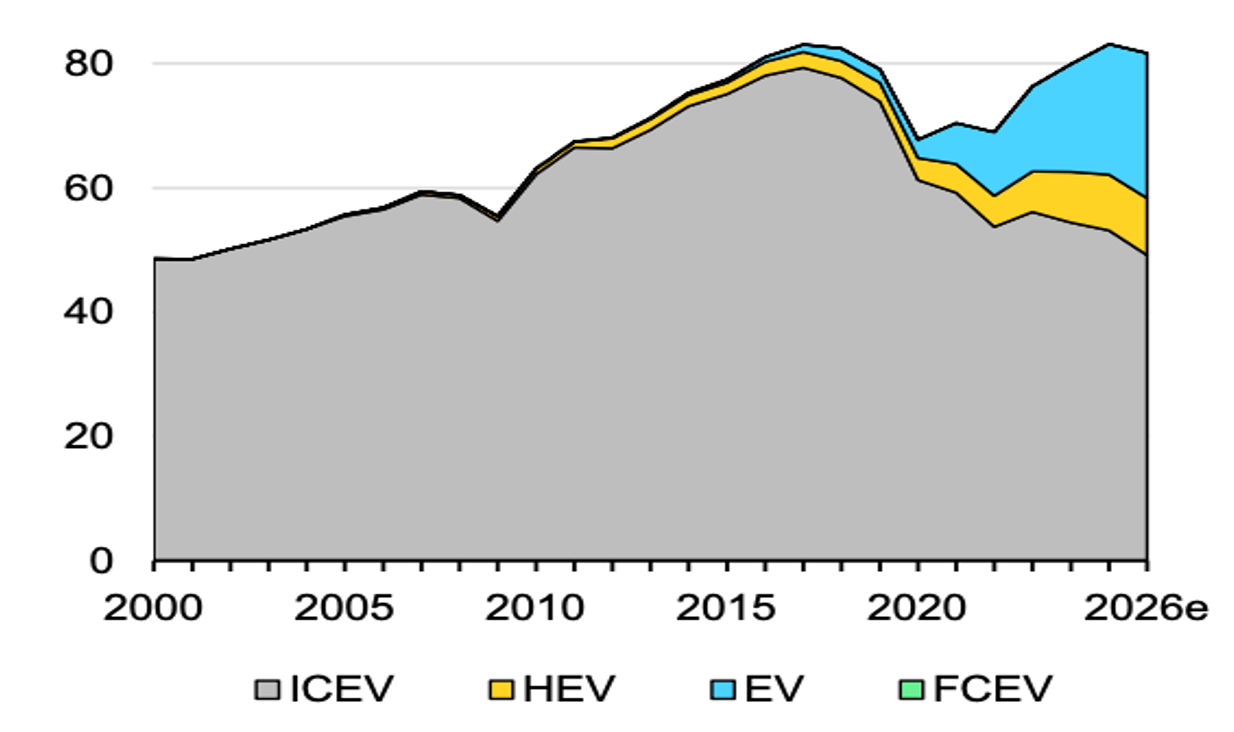
The trend is also blindingly obvious in electric vehicles for road transportation, which were “additive” until suddenly they weren’t:
Global new car and light truck sales, 2000 to H1 2026. Source: IEA
Having peaked in 2017, internal combustion vehicle sales are down by around 1/3 over the past decade. Legacy car companies that have been listening to those telling them EVs don’t work and are not taking over are going to have a very rough ride.
Q: Is it plausible that we reach a tipping point in the dominance of renewables over fossil fuels, before passing a disastrous threshold in climate change? Are we running fast enough before the clock runs out?
A: First, let me say that the invocation of tipping points and dangerous thresholds in climate change is far too simplistic.
There are potential climate tipping points, but their most disastrous impacts will take centuries or even millennia to hit us. Whether it is the melting of the ice sheets or the flipping of the Amazon into a tundra, these are not things that happen in a few decades. Even the breathless press coverage of the potential collapse of the AMOC ignores the science that show it happening next century at the earliest, not this century. For instance a Guardian op-ed stating that “AMOC collapse could change Europe’s climate 10x faster than expected” failed to point out that in the paper on which the headline was based, the rapid collapse only begins a full 1,750 years after a hypothetical 80x increase in the flow of Greenland melt-water.
That’s not to say we should ignore tipping points, it’s just a plea for people to understand what tipping points are and aren’t, and what time constants they follow. While there are negative impacts happening right now and others that are expected to be felt within decades, they are not inevitable heralds of tipping points or “disastrous thresholds”.
Can renewables grow fast enough to avoid any risk of passing climate tipping points? The reality is that I don’t know, and neither does anyone else. What I do know that renewables are a big part of what has already slowed the growth in emissions, and are about to help turn it into reverse, and they also have enormous co-benefits in terms of reduced local pollution and increased citizen engagement in climate action.
So any plan to address climate change that is based on minimising the uptake of renewables, batteries and electrification of transport and heat is deeply irresponsible.
Q: It is an understatement to say that CO₂ emissions are not moving in the right direction. Shouldn’t we simply accept that we need to use less energy?
A: No. Over the past 15 years, the global economy has grown by 50%, and emissions have only increased 9% - a stunning decoupling.
We are a lot nearer to peak emissions than people think and moving in the right direction, albeit far too slowly. In fact, had it not been for Russia’s invasion of Ukraine and the US’s attack on Iran, fossil gas prices would have remained low, and decoupling would have been even more dramatic. Global coal consumption would most likely have peaked in 2011. Of course we need to move faster, but we must not give in to simple narratives of failure.
Should we use less energy? Well, of course we should use less Primary Energy, since 80% of that is fossil. But as described above, Primary Energy is about how we currently choose to meet our energy needs, it is not a given at all.
It is the consumption of Useful Energy that correlates with human progress, otherwise known as energy services: warm homes, air conditioning, refrigerated food, travel, better infrastructure etc. I consider it completely immoral, and also utterly pointless, to demand that humans turn their back on progress and fulfilment. Degrowth is an idea that appeals only to a very narrow group of young and middle-class people who have easy lives. I have never seen anyone who has lived under threat of hunger or unemployment espouse degrowth - at least not for themselves.
Any politician that stands on a platform of degrowth has no chance of being elected. And any politician who tries to implement degrowth would never be re-elected.
Q: If Fressoz is right, the only way to truly combat climate change is through “amputation”—using less energy. Technological advancement is just a ‘plus’ in this scenario. What is your view on that?
A: As explained above, he’s wrong.
Q: Is drastic energy “amputation” a realistic prospect? Will people accept it (especially in developing countries)?
A: As above, no: “amputation” or degrowth, is neither a morally acceptable nor realistic prospect.
Q: How can we break out of the symbiosis of different energy sources, particularly the entanglement with fossil fuels?
A: Since “symbiosis” is a fake construct, we don’t need to break out of it, we just need to ignore it. All we have to do is ensure that each year, the growth in clean energy exceeds the growth in demand for energy services. Keep doing that, for long enough, across enough of the global economy, and everything else will look after itself as best as can be expected. The rest is noise.
Talking of noise, since you’ve read this far, here’s the 1992 Eurodance hit “More and More and More” by Captain Hollywood Project. Enjoy.
* Coda
In early feedback on social media a lot of people objected to the line “How quickly this proceeds, and whether fossil fuels are ever entirely forced off the system, is not the point.”
It was clumsily written. What I should have said is “How quickly this proceeds, and whether fossil fuels are ever entirely forced off the system, is not the point in terms of debunking Fressoz’s thesis”.
Of course the transition needs to be rapid and complete if we are to limit the worst impacts of climate change. I wanted to point out that the fact that we are clearly not on track for global net zero by 2050 does not mean that we are not living through the early decades into a profound transition.
While I push back against those who get out over their skis in terms of claiming imminent climate catastrophe, nothing about what I write should ever suggest I don’t think rapid action is required. Climate action is difficult for society precicely because we need to made profound changes to every aspect of our economy over a period of many decades, in the face of a threat that is existential but in its worst impacts not immediate.
I hesitated to respond to you because your text contains numerous errors, which forces me to write a rather lengthy response
1° Your "simple arithmetic" is decidedly far too simplistic.
It might, at most, be acceptable for electricity production, which accounts for 40% of emissions.
But fossil fuels will unfortunately be much more difficult to displace in so-called "hard to abate" sectors: aviation, steel production, cement manufacturing, maritime commerce, not to mention the elephant in the room: the global food system, which accounts for 34% of emissions (see the EDGAR FOOD survey by the European Commission's JRC).
2° You write: "How quickly this proceeds, and whether fossil fuels are ever entirely forced off the system, is not the point. The point is that clean energy will, within a few decades become the dominant source of energy in our economy".
I believe that all people genuinely concerned about climate warming will be rather unconvinced by your formulation: the question is precisely the one you dismiss with a wave of your hand. We must reach net zero, and reach it as quickly as possible to limit climate warming damage.
That renewables will become the dominant energy source in the future (around 2040) is likely, and this is moreover what the IEA announces. But this fact tells us nothing about the pace of fossil fuel reduction, and even less about the date of achieving carbon neutrality. The IEA forecasts a decline in coal (thanks to renewable electricity) but a high plateau for gas and oil until 2050.
3° In the next paragraph, you make the common error that many (not serious) people make: using on the climate question a conception of energy transition "in relative terms" dating back to the 1970s and more specifically to the work of Italian scientist Cesare Marchetti. If the history of the energy transition concept interests you, you can profitably consult chapters 6 to 12 of my book.
4° Your analogy with mobile phones makes little sense. You confuse technological dynamics (where substitutions have indeed occurred in the past) with material and energetic dynamics that are, aside from rare exceptions (whale oil, asbestos, mercury, and sheep's wool), cumulative. If we think in material terms—that is, in the terms that matter for the environment—a more interesting question would be whether material consumption (copper, for example) decreased with the end of the landline telephone, which is manifestly not the case. Your example demonstrates the opposite of what you believe.
5° Same series of errors in the next paragraph. « Traditional biomass » did not collapse in the developed world. I guess you have heard of Drax power plant in Britain which burns approximately 4 times more wood than Britain did two centuries ago. Even worse : I really don't know where you got the idea that human muscular power disappeared entirely (??) Not only did the number of humans increased greatly in the 20th century, but so did the number of manual workers (in artisanal mines or in construction, for example). On this subject may I recommend the forthcoming book on the history of production by my colleague David Edgerton. Moreover, what matters for the climate—namely, biomass consumption for human food—has increased enormously.
6° My book never speaks of "natural law"; I know the meaning of the word "exergy"; I know that an electron allows diverse and varied uses; I know that the electric motor is far more efficient than a petrol engine or a steam engine; and I know the difference between final energy and primary energy, thank you. You will see, for example, in chapter 2, how historiography of the "industrial revolution" tends to overestimate energy abundance, for instance around 1850, because it relies on primary energy data (tons of coal consumed at the national scale).
7° The next paragraph reproduces a simplistic vision of innovation diffusion following S-shaped curves. My book traces the origins of the use of the logistic curve in futurology (as early as the 1930s). Arthur Downing wrote an interesting text some time ago on contemporary misuses of the S-curve in the energy field. You should refer to it.
8° Electric vehicles are more efficient than petrol cars. Unfortunately, they don't grow on trees, and life cycle analyses generally indicate a reduction of about 60% of CO2 emissions per km. Progress, then, but which leaves us far from carbon neutrality. If only with this trivial example, it appears that the symbiotic effect does indeed exist. You should consult the literature on life cycle assessments. For example, Xiang Li et al., "Effect of electric vehicles and renewable electricity on future life cycle air emissions from China's road transport fleet," Energy, 318, 2025. According to the most optimistic scenario (rapid decarbonization of the electricity mix + rapid EV diffusion), emissions from land transport in China will be divided by 2 in 2050.
9° Last piece of advice: avoid criticizing a book you have manifestly not read.
Thank you, Michael. I’ve read the book and was indeed surprised by Fressoz’s obvious thermodynamic errors and misinterpretations. With your kind permission, I’ll refer to this (your) rebuttal on Substack whenever the book’s ‘findings’ are cited (generally by cranky uncles with petrol-hats).



Dear Mr. Lieberich,
I hesitated to respond to you because your text contains numerous errors, which forces me to write a rather lengthy response
1° Your "simple arithmetic" is decidedly far too simplistic.
It might, at most, be acceptable for electricity production, which accounts for 40% of emissions.
But fossil fuels will unfortunately be much more difficult to displace in so-called "hard to abate" sectors: aviation, steel production, cement manufacturing, maritime commerce, not to mention the elephant in the room: the global food system, which accounts for 34% of emissions (see the EDGAR FOOD survey by the European Commission's JRC).
2° You write: "How quickly this proceeds, and whether fossil fuels are ever entirely forced off the system, is not the point. The point is that clean energy will, within a few decades become the dominant source of energy in our economy".
I believe that all people genuinely concerned about climate warming will be rather unconvinced by your formulation: the question is precisely the one you dismiss with a wave of your hand. We must reach net zero, and reach it as quickly as possible to limit climate warming damage.
That renewables will become the dominant energy source in the future (around 2040) is likely, and this is moreover what the IEA announces. But this fact tells us nothing about the pace of fossil fuel reduction, and even less about the date of achieving carbon neutrality. The IEA forecasts a decline in coal (thanks to renewable electricity) but a high plateau for gas and oil until 2050.
3° In the next paragraph, you make the common error that many (not serious) people make: using on the climate question a conception of energy transition "in relative terms" dating back to the 1970s and more specifically to the work of Italian scientist Cesare Marchetti. If the history of the energy transition concept interests you, you can profitably consult chapters 6 to 12 of my book.
4° Your analogy with mobile phones makes little sense. You confuse technological dynamics (where substitutions have indeed occurred in the past) with material and energetic dynamics that are, aside from rare exceptions (whale oil, asbestos, mercury, and sheep's wool), cumulative. If we think in material terms—that is, in the terms that matter for the environment—a more interesting question would be whether material consumption (copper, for example) decreased with the end of the landline telephone, which is manifestly not the case. Your example demonstrates the opposite of what you believe.
5° Same series of errors in the next paragraph. « Traditional biomass » did not collapse in the developed world. I guess you have heard of Drax power plant in Britain which burns approximately 4 times more wood than Britain did two centuries ago. Even worse : I really don't know where you got the idea that human muscular power disappeared entirely (??) Not only did the number of humans increased greatly in the 20th century, but so did the number of manual workers (in artisanal mines or in construction, for example). On this subject may I recommend the forthcoming book on the history of production by my colleague David Edgerton. Moreover, what matters for the climate—namely, biomass consumption for human food—has increased enormously.
6° My book never speaks of "natural law"; I know the meaning of the word "exergy"; I know that an electron allows diverse and varied uses; I know that the electric motor is far more efficient than a petrol engine or a steam engine; and I know the difference between final energy and primary energy, thank you. You will see, for example, in chapter 2, how historiography of the "industrial revolution" tends to overestimate energy abundance, for instance around 1850, because it relies on primary energy data (tons of coal consumed at the national scale).
7° The next paragraph reproduces a simplistic vision of innovation diffusion following S-shaped curves. My book traces the origins of the use of the logistic curve in futurology (as early as the 1930s). Arthur Downing wrote an interesting text some time ago on contemporary misuses of the S-curve in the energy field. You should refer to it.
8° Electric vehicles are more efficient than petrol cars. Unfortunately, they don't grow on trees, and life cycle analyses generally indicate a reduction of about 60% of CO2 emissions per km. Progress, then, but which leaves us far from carbon neutrality. If only with this trivial example, it appears that the symbiotic effect does indeed exist. You should consult the literature on life cycle assessments. For example, Xiang Li et al., "Effect of electric vehicles and renewable electricity on future life cycle air emissions from China's road transport fleet," Energy, 318, 2025. According to the most optimistic scenario (rapid decarbonization of the electricity mix + rapid EV diffusion), emissions from land transport in China will be divided by 2 in 2050.
9° Last piece of advice: avoid criticizing a book you have manifestly not read.
Best regards,
Jean-Baptiste Fressoz.
Thank you, Michael. I’ve read the book and was indeed surprised by Fressoz’s obvious thermodynamic errors and misinterpretations. With your kind permission, I’ll refer to this (your) rebuttal on Substack whenever the book’s ‘findings’ are cited (generally by cranky uncles with petrol-hats).